Important topics in computer graphics include
user interface design,
sprite graphics,
vector graphics,
3D modeling,
shaders,
GPUdesign, and
computer vision, among others. The overall methodology depends heavily on the underlying sciences of
geometry,
optics, and
physics. Computer graphics is responsible for displaying art and image data effectively and beautifully to the user, and processing image data received from the physical world. The interaction and understanding of computers and interpretation of data has been made easier because of computer graphics. Computer graphic development has had a significant impact on many types of media and has revolutionized
animation,
movies,
advertising,
video games, and
graphic design generally.
Overview[edit]
The term computer graphics has been used a broad sense to describe "almost everything on computers that is not text or sound".
[1] Typically, the term
computer graphics refers to several different things:
- the representation and manipulation of image data by a computer
- the various technologies used to create and manipulate images
- the sub-field of computer science which studies methods for digitally synthesizing and manipulating visual content, see study of computer graphics
Computer graphics is widespread today. Computer imagery is found on television, in newspapers, for example in weather reports, or for example in all kinds of medical investigation and surgical procedures. A well-constructed
graph can present complex statistics in a form that is easier to understand and interpret. In the media "such graphs are used to illustrate papers, reports, thesis", and other presentation material.
[2]
Many powerful tools have been developed to visualize data. Computer generated imagery can be categorized into several different types: two dimensional (2D), three dimensional (3D), and animated graphics. As technology has improved,
3D computer graphics have become more common, but
2D computer graphics are still widely used. Computer graphics has emerged as a sub-field of
computer science which studies methods for digitally synthesizing and manipulating visual content. Over the past decade, other specialized fields have been developed like
information visualization, and
scientific visualization more concerned with "the visualization of
three dimensional phenomena (architectural, meteorological, medical,
biological, etc.), where the emphasis is on realistic renderings of volumes, surfaces, illumination sources, and so forth, perhaps with a dynamic (time) component".
[3]
History[edit]
Introduction[edit]
The precursor sciences to the development of modern computer graphics were the advances in
electrical engineering,
electronics, and
television that took place during the first half of the twentieth century. Screens could display art since the
Lumiere brothers' use of
mattes to create special effects for the earliest films dating from 1895, but such displays were limited and not interactive. The first
cathode ray tube, the
Braun tube, was invented in 1897 - it in turn would permit the
oscilloscope and the military
control panel - the more direct precursors of the field, as they provided the first two-dimensional electronic displays that responded to programmatic or user input. Nevertheless, computer graphics remained relatively unknown as a discipline until the 1950s and the post-
World War II period - during which time, the discipline emerged from a combination of both pure
university and
laboratory academic research into more advanced computers and the
United States military's further development of technologies like
radar, advanced
aviation, and
rocketry developed during the war. New kinds of displays were needed to process the wealth of information resulting from such projects, leading to the development of computer graphics as a discipline.
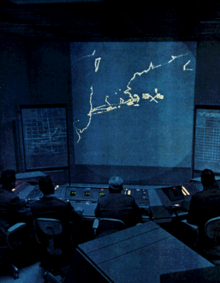
SAGE Sector Control Room.
Early projects like the
Whirlwind and
SAGE Projects introduced the
CRT as a viable
display and interaction interface and introduced the
light pen as an
input device.
Douglas T. Ross of the Whirlwind SAGE system performed a personal experiment in 1954 in which a small program he wrote captured the movement of his finger and displayed its vector (his traced name) on a display scope. One of the first interactive video games to feature recognizable, interactive graphics –
Tennis for Two – was created for an oscilloscope by
William Higinbotham to entertain visitors in 1958 at
Brookhaven National Laboratory and simulated a tennis match. In 1959,
Douglas T. Rossinnovated again while working at MIT on transforming mathematic statements into computer generated machine tool vectors, and took the opportunity to create a display scope image of a
Disney cartoon character.
[4]
Electronics pioneer
Hewlett-Packard went public in 1957 after incorporating the decade prior, and established strong ties with
Stanford University through its founders, who were
alumni. This began the decades-long transformation of the southern
San Francisco Bay Areainto the world's leading computer technology hub - now known as
Silicon Valley. The field of computer graphics developed with the emergence of computer graphics hardware. Further advances in computing led to greater advancements in
interactive computer graphics. In 1959, the
TX-2 computer was developed at
MIT's Lincoln Laboratory. The TX-2 integrated a number of new man-machine interfaces. A
light pen could be used to draw sketches on the computer using
Ivan Sutherland's revolutionary
Sketchpad software.
[5] Using a light pen, Sketchpad allowed one to draw simple shapes on the computer screen, save them and even recall them later. The light pen itself had a small
photoelectric cell in its tip. This cell emitted an electronic pulse whenever it was placed in front of a computer screen and the screen's
electron gun fired directly at it. By simply timing the electronic pulse with the current location of the electron gun, it was easy to pinpoint exactly where the pen was on the screen at any given moment. Once that was determined, the computer could then draw a cursor at that location. Sutherland seemed to find the perfect solution for many of the graphics problems he faced. Even today, many standards of computer graphics interfaces got their start with this early Sketchpad program. One example of this is in drawing constraints. If one wants to draw a square for example, they do not have to worry about drawing four lines perfectly to form the edges of the box. One can simply specify that they want to draw a box, and then specify the location and size of the box. The software will then construct a perfect box, with the right dimensions and at the right location. Another example is that Sutherland's software modeled objects - not just a picture of objects. In other words, with a model of a car, one could change the size of the tires without affecting the rest of the car. It could stretch the body of car without deforming the tires.
The phrase “computer graphics” itself was coined in 1960 by
William Fetter, a graphic designer for
Boeing.
[5] This old quote in many secondary sources comes complete with the following sentence: (
Fetter has said that the terms were actually given to him by Verne Hudson of the Wichita Division of Boeing.)
[6] In 1961 another student at MIT,
Steve Russell, created the second video game,
Spacewar. Written for the
DEC PDP-1, Spacewar was an instant success and copies started flowing to other PDP-1 owners and eventually DEC got a copy.
[citation needed] The engineers at DEC used it as a diagnostic program on every new PDP-1 before shipping it. The sales force picked up on this quickly enough and when installing new units, would run the "world's first video game" for their new customers. (Higginbotham's
Tennis For Two had beaten
Spacewar by almost three years; but it was almost unknown outside of a research or academic setting.)
E. E. Zajac, a scientist at
Bell Telephone Laboratory (BTL), created a film called "Simulation of a two-giro gravity attitude control system" in 1963.
[7] In this computer-generated film, Zajac showed how the attitude of a satellite could be altered as it orbits the Earth. He created the animation on an
IBM 7090 mainframe computer. Also at BTL,
Ken Knowlton,
Frank Sinden and
Michael Noll started working in the computer graphics field. Sinden created a film called
Force, Mass and Motion illustrating
Newton's laws of motion in operation. Around the same time, other scientists were creating computer graphics to illustrate their research. At
Lawrence Radiation Laboratory, Nelson Max created the films
Flow of a Viscous Fluid and
Propagation of Shock Waves in a Solid Form.
Boeing Aircraft created a film called
Vibration of an Aircraft.
Also sometime in the early 1960s,
automobiles would also provide a boost through the early work of
Pierre Bézier at
Renault, who used
Paul de Casteljau's curves - now called
Bézier curves after Bézier's work in the field - to develop 3d modeling techniques for
Renault car bodies. These curves would form the foundation for much curve-modeling work in the field, as curves - unlike polygons - are mathematically complex entities to draw and model well.
It was not long before major corporations started taking an interest in computer graphics.
TRW,
Lockheed-Georgia,
General Electric and
Sperry Rand are among the many companies that were getting started in computer graphics by the mid-1960s. IBM was quick to respond to this interest by releasing the
IBM 2250 graphics terminal, the first commercially available graphics computer.
Ralph Baer, a supervising engineer at
Sanders Associates, came up with a home
video game in 1966 that was later licensed to
Magnavox and called the
Odyssey. While very simplistic, and requiring fairly inexpensive electronic parts, it allowed the player to move points of light around on a screen. It was the first consumer computer graphics product.
David C. Evans was director of engineering at
Bendix Corporation's computer division from 1953 to 1962, after which he worked for the next five years as a visiting professor at Berkeley. There he continued his interest in computers and how they interfaced with people. In 1966, the
University of Utah recruited Evans to form a computer science program, and computer graphics quickly became his primary interest. This new department would become the world's primary research center for computer graphics.
Also in 1966,
Ivan Sutherland continued to innovate at MIT when he invented the first computer controlled
head-mounted display (HMD). Called the Sword of Damocles because of the hardware required for support, it displayed two separate wireframe images, one for each eye. This allowed the viewer to see the computer scene in
stereoscopic 3D. After receiving his Ph.D. from MIT, Sutherland became Director of Information Processing at
ARPA (Advanced Research Projects Agency), and later became a professor at Harvard. In 1967 Sutherland was recruited by Evans to join the computer science program at the
University of Utah. There he perfected his HMD. Twenty years later, NASA would re-discover his techniques in their
virtual reality research. At Utah, Sutherland and Evans were highly sought after consultants by large companies but they were frustrated at the lack of graphics hardware available at the time so they started formulating a plan to start their own company. In 1969, the
ACM initiated A Special Interest Group on Graphics (
SIGGRAPH) which organizes
conferences,
graphics standards, and publications within the field of computer graphics. In 1973, the first annual SIGGRAPH conference was held, which has become one of the focuses of the organization. SIGGRAPH has grown in size and importance as the field of computer graphics has expanded over time.
Many of the most important early breakthroughs in the transformation of graphics from utilitarian to realistic occurred at the
University of Utah in the 1970s, which had hired
Ivan Sutherland away from
MIT. Sutherland's graphics class would contribute a number of significant pioneers to the field, including a student by the name of
Edwin Catmull - a later founder of
Pixar. Because of
David C. Evans' and Sutherland's presence, UU was gaining quite a reputation as the place to be for computer graphics research so Catmull went there to learn 3D animation. Catmull had just come from The Boeing Company and had been working on his degree in physics. Growing up on
Disney, Catmull loved animation yet quickly discovered that he did not have the talent for drawing. Now Catmull (along with many others) saw computers as the natural progression of animation and they wanted to be part of the revolution. The first animation that Catmull saw was his own. He created an animation of his hand opening and closing. It became one of his goals to produce a feature-length motion picture using computer graphics. In the same class,
Fred Parke created an animation of his wife's face.
As the UU computer graphics laboratory was attracting people from all over,
John Warnock was one of those early pioneers; he would later found
Adobe Systems and create a revolution in the publishing world with his
PostScript page description language, and Adobe would go on later to create the industry standard
photo editing software in
Adobe Photoshop and the movie industry's
special effects standard in
Adobe After Effects. Tom Stockham led the image processing group at UU which worked closely with the computer graphics lab. Jim Clark was also there; he would later found Silicon Graphics, Inc. The first major advance in 3D computer graphics was created at UU by these early pioneers, the hidden-surface algorithm. In order to draw a representation of a 3D object on the screen, the computer must determine which surfaces are "behind" the object from the viewer's perspective, and thus should be "hidden" when the computer creates (or renders) the image. The
3D Core Graphics System (or
Core) was the first graphical standard to be developed. A group of 25 experts of the
ACM Special Interest Group SIGGRAPH developed this "conceptual framework". The specifications were published in 1977, and it became a foundation for many future developments in the field.
The 1980s began to see the modernization and commercialization of computer graphics. As the
home computer proliferated, a subject which had previously been an academics-only discipline was adopted by a much larger audience, and the number of computer graphics developers increased significantly.
In the early 1980s, the availability of
bit-slice and
16-bit microprocessors started to revolutionise high-resolution computer graphics terminals which now increasingly became intelligent, semi-standalone and standalone workstations. Graphics and application processing were increasingly migrated to the intelligence in the workstation, rather than continuing to rely on central mainframe and
mini-computers. Typical of the early move to high resolution computer graphics intelligent workstations for the computer-aided engineering market were the Orca 1000, 2000 and 3000 workstations, developed by Orcatech of Ottawa, a spin-off from
Bell-Northern Research, and led by
David Pearson, an early workstation pioneer. The Orca 3000 was based on Motorola 68000 and AMD bit-slice processors and had Unix as its operating system. It was targeted squarely at the sophisticated end of the design engineering sector. Artists and graphic designers began to see the personal computer, particularly the
Commodore Amiga and
Macintosh, as a serious design tool, one that could save time and draw more accurately than other methods. The Macintosh remains a highly popular tool for computer graphics among graphic design studios and businesses. Modern computers, dating from the 1980s, often use
graphical user interfaces (GUI) to present data and information with symbols, icons and pictures, rather than text. Graphics are one of the five key elements of
multimedia technology.
Japan's
Osaka University developed the
LINKS-1 Computer Graphics System, a
supercomputer that used up to 257
Zilog Z8001 microprocessors, in 1982, for the purpose of rendering realistic
3D computer graphics. According to the Information Processing Society of Japan: "The core of 3D image rendering is calculating the luminance of each pixel making up a rendered surface from the given viewpoint,
light source, and object position. The LINKS-1 system was developed to realize an image rendering methodology in which each pixel could be parallel processed independently using
ray tracing. By developing a new software methodology specifically for high-speed image rendering, LINKS-1 was able to rapidly render highly realistic images. It was used to create the world's first 3D
planetarium-like video of the entire
heavens that was made completely with computer graphics. The video was presented at the
Fujitsu pavilion at the 1985 International Exposition in
Tsukuba."
[8] The LINKS-1 was the world's most powerful
computer, as of 1984.
[9]
The continuing popularity of
Star Wars and other science fiction franchises were relevant in cinematic CGI at this time, as
Lucasfilm and
Industrial Light & Magic became known as the "go-to" house by many other studios for topnotch computer graphics in film. Important advances in
chroma keying ("bluescreening", etc.) were made for the later films of the original trilogy. Two other pieces of video would also outlast the era as historically relevant:
Dire Straits' iconic, near-fully-CGI video for their song "
Money For Nothing" in 1985, which popularized CGI among music fans of that era, and a scene from
Young Sherlock Holmes the same year featuring the first fully CGI character in a feature movie (an animated stained-glass
knight). In 1988, the first
shaders - small programs designed specifically to do
shading as a separate algorithm - were developed by
Pixar, which had already spun off from Industrial Light & Magic as a separate entity - though the public would not see the results of such technological progress until the next decade. In the late 1980s,
SGI computers were used to create some of the first fully computer-generated
short films at
Pixar, and Silicon Graphics machines were considered a high-water mark for the field during the decade.
The 1980s is also called the
golden era of
videogames; millions-selling systems from
Atari,
Nintendo and
Sega, among other companies, exposed computer graphics for the first time to a new, young, and impressionable audience - as did
MS-DOS-based personal computers,
Apple IIs and
Macs, and
Amigas, which also allowed users to program their own games if skilled enough.
Demoscenes and
shareware games proliferated;
John Carmack, a later 3D innovator, would start out in this period developing sprite-based games. In the
arcades, advances were made in commercial,
real-time 3D graphics. In 1988, the first dedicated real-time 3D
graphics boards were introduced in arcades, with the
Namco System 21[10] and
Taito Air System.
[11] This innovation would be the precursor of the later home
graphics processing unit or GPU, a technology where a separate and very powerful chip is used in
parallel processing with a
CPU to optimize graphics.
The 1990s' overwhelming note was the emergence of
3D modeling on a mass scale, and an impressive rise in the quality of CGI generally. Home computers became able to take on rendering tasks that previously had been limited to workstations costing thousands of dollars; as
3D modelersbecame available for home systems, the popularity of
Silicon Graphics workstations declined and powerful
Microsoft Windows and
Apple Macintosh machines running
Autodesk products like
3D Studio or other home rendering software ascended in importance. By the end of the decade, the
GPU would begin its rise to the prominence it still enjoys today.
The field began to see the first rendered graphics that could truly pass as
photorealistic to the untrained eye (though they could not yet do so with a trained CGI artist) and
3D graphics became far more popular in
gaming,
multimedia and
animation. At the end of the 1980s and the beginning of the nineties were created, in France, the very first computer graphics TV series:
La Vie des bêtes by studio Mac Guff Ligne (1988),
Les Fables Géométriques (1989-1991) by studio Fantôme, and
Quarxs, the first HDTV computer graphics series by
Maurice Benayoun and
François Schuiten (studio Z-A production, 1990–1993).
In film,
Pixar began its serious commercial rise in this era under
Edwin Catmull, with its first major film release, in 1995 -
Toy Story - a critical and commercial success of nine-figure magnitude. The studio to invent the programmable
shader would go on to have many animated hits, and its work on prerendered video animation is still considered an industry leader and research trailbreaker.
In videogames, in 1992,
Virtua Racing, running on the
Sega Model 1 arcade system board, laid the foundations for fully 3D
racing games and popularized real-time
3D polygonal graphics among a wider audience in the
video game industry.
[12] The
Sega Model 2 in 1993 and
Sega Model 3 in 1996 subsequently pushed the boundaries of commercial, real-time 3D graphics. Back on the PC,
Wolfenstein 3D,
Doom and
Quake, three of the first massively popular 3D
first-person shooter games, were released by
id Software to critical and popular acclaim during this decade using a rendering engine innovated primarily by
John Carmack. The
Sony Playstation and
Nintendo 64, among other consoles, sold in the millions and popularized 3D graphics for home gamers. Certain late-90's first-generation 3D titles became seen as influential in popularizing 3D graphics among console users, such as
platform games Super Mario 64 and
The Legend Of Zelda: Ocarina Of Time, and early 3D
fighting games like
Virtua Fighter,
Battle Arena Toshinden, and
Tekken.
Technology and algorithms for rendering continued to improve greatly. In 1996, Krishnamurty and Levoy invented
normal mapping - an improvement on Jim Blinn's
bump mapping. 1999 saw
Nvidia release the seminal
GeForce 256, the first home
video card billed as a
graphics processing unit or GPU, which in its own words contained "integrated
transform,
lighting,
triangle setup/
clipping, and
rendering engines". By the end of the decade, computers adopted common frameworks for graphics processing such as
DirectXand
OpenGL. Since then, computer graphics have only become more detailed and realistic, due to more powerful
graphics hardware and
3D modeling software.
AMD also became a leading developer of graphics boards in this decade, creating a "duopoly" in the field which exists to this day.
![[icon]](https://upload.wikimedia.org/wikipedia/commons/thumb/1/1c/Wiki_letter_w_cropped.svg/20px-Wiki_letter_w_cropped.svg.png) | This section requires expansion.(October 2012) |
CGI became ubiquitous in earnest during this era.
Video games and CGI
cinema had spread the reach of computer graphics to the mainstream by the late 1990s, and continued to do so at an accelerated pace in the 2000s. CGI was also adopted
en masse for
television advertisements widely in the late 1990s and 2000s, and so became familiar to a massive audience.
The continued rise and increasing sophistication of the
graphics processing unit was crucial to this decade, and 3D rendering capabilities became a standard feature as 3D-graphics GPUs became considered a necessity for
desktop computer makers to offer. The
Nvidia GeForceline of graphics cards dominated the market in the early decade with occasional significant competing presence from
ATI.
[13] As the decade progressed, even low-end machines usually contained a 3D-capable GPU of some kind as
Nvidia and
AMD both introduced low-priced chipsets and continued to dominate the market.
Shaders which had been introduced in the 1980s to perform specialized processing on the GPU would by the end of the decade become supported on most consumer hardware, speeding up graphics considerably and allowing for greatly improved
texture and
shading in computer graphics via the widespread adoption of
normal mapping,
bump mapping, and a variety of other techniques allowing the simulation of a great amount of detail.
Computer graphics used in films and
video games gradually began to be realistic to the point of entering the
uncanny valley.
CGI movies proliferated, with traditional animated
cartoon films like
Ice Age and
Madagascar as well as numerous
Pixar offerings like
Finding Nemo dominating the box office in this field. The
Final Fantasy: The Spirits Within, released in 2001, was the first fully computer-generated feature film to use photorealistic CGI characters and be fully made with motion capture.
[14] The film was not a box-office success, however.
[15] Some commentators have suggested this may be partly because the lead CGI characters had facial features which fell into the "uncanny valley".
[16] Other animated films like
The Polar Express drew attention at this time as well.
Star Wars also resurfaced with its prequel trilogy and the effects continued to set a bar for CGI in film.
In
videogames, the
Sony Playstation 2 and
3, the
Microsoft Xbox line of consoles, and offerings from
Nintendo such as the
GameCube maintained a large following, as did the
Windows PC. Marquee CGI-heavy titles like the series of
Grand Theft Auto,
Assassin's Creed,
Final Fantasy,
Bioshock,
Kingdom Hearts,
Mirror's Edge and dozens of others continued to approach
photorealism, grow the videogame industry and impress, until that industry's revenues became comparable to those of movies.
Microsoft made a decision to expose
DirectX more easily to the independent developer world with the
XNA program, but it was not a success. DirectX itself remained a commercial success, however.
OpenGL continued to mature as well, and it and
DirectX improved greatly; the second-generation shader languages
HLSL and
GLSL began to be popular in this decade.
| This section requires expansion.(October 2014) |
In the early half of the 2010s, CGI is nearly ubiquitous in video, pre-rendered graphics are nearly scientifically
photorealistic, and realtime graphics on a suitably high-end system may simulate photorealism to the untrained eye.
Texture mapping has matured into a multistage process with many layers; generally it is not uncommon to implement texture mapping,
bump mapping or
isosurfaces,
normal mapping, lighting maps including
specular highlights and
reflection techniques, and
shadow volumes into one rendering engine using
shaders, which are maturing considerably. Shaders are now very nearly a necessity for advanced work in the field, providing considerable complexity in manipulating
pixels,
vertices, and
textures on a per-element basis, and countless possible effects. Their shader languages
HLSL and
GLSL are active fields of research and development.
Physically-based rendering or PBR, which implements even more maps to simulate real optic light flow, is an active research area as well. Experiments into the processing power required to provide graphics in
real time at ultra-high-resolution modes like
Ultra HD are beginning, though beyond reach of all but the highest-end hardware.
Image types[edit]
Two-dimensional[edit]
2D computer graphics are mainly used in applications that were originally developed upon traditional
printing and
drawing technologies such as typography. In those applications, the two-dimensional
image is not just a representation of a real-world object, but an independent artifact with added semantic value; two-dimensional models are therefore preferred, because they give more direct control of the image than
3D computer graphics, whose approach is more akin to
photography than to
typography.
Personal;kaya ko ito inilagay sa aking blogspot dahil;,diba tayo pag magcocomputer ang pangunahin nating ginagawa
ay kumuha ng photos at iba pa pero dapat hindi lang yon yung alam nati pati dapat alam natinkung kanino ang picture
nakinuha natin.


![[icon]](https://en.wikipedia.org/wiki/File:Wiki_letter_w_cropped.svg)


